

A Public Limited Company is a type of corporate entity that offers limited liability protection to its shareholders and allows businesses to raise capital by offering shares to the public. It is suitable for large-scale businesses that require significant investment and expansion opportunities.
Public Limited Companies are registered under the Companies Act, 2013, and have the ability to list their shares on stock exchanges through Initial Public Offerings (IPO). This structure is ideal for businesses planning long-term growth, public investment, and large operational capacity.
By registering a Public Limited Company, businesses gain credibility, better funding opportunities, and a structured governance framework that supports scalability and compliance.

Public Limited Company registration in India follows a structured online process under the Companies Act, 2013. Below is the step-by-step process to incorporate a Public Limited Company.
Public Limited Company registration is a fully digital process. Therefore, obtaining a Digital Signature Certificate (DSC) is mandatory for all proposed directors and subscribers.
The DSC is required to sign electronic documents during company registration.
The DSC process includes:
Once verified, the DSC is typically issued within 24–48 hours.
After obtaining the DSC, the next step is to apply for company name approval through the SPICe+ RUN (Reserve Unique Name) service.
While applying for name approval:
It is recommended to check name availability before submission to avoid rejection.
Once the company name is approved, the incorporation application must be submitted through the SPICe+ (Simplified Proforma for Incorporating Company Electronically) Form.
This form includes essential company details such as:
This step ensures that all company registration details are recorded with the Ministry of Corporate Affairs (MCA).
Along with the SPICe+ form, the Memorandum of Association (MOA) and Articles of Association (AOA) must be filed electronically.
The MOA defines:
It serves as the foundation document of the company.
The AOA outlines:
These documents regulate the functioning of the company.
After successful verification by the Ministry of Corporate Affairs (MCA), the following documents are issued:
Once these documents are issued, the company can:
Professional assistance during this stage ensures faster approvals and smooth incorporation.
To successfully complete Public Limited Company Registration, specific documents related to directors, shareholders, and the registered office must be submitted for verification.
The following documents are required from all proposed directors and shareholders:
These documents help verify the identity and residential address of company members.
Every Public Limited Company must provide valid proof of its registered office location.
Required documents include:
These documents confirm the legal existence of the company’s registered address.
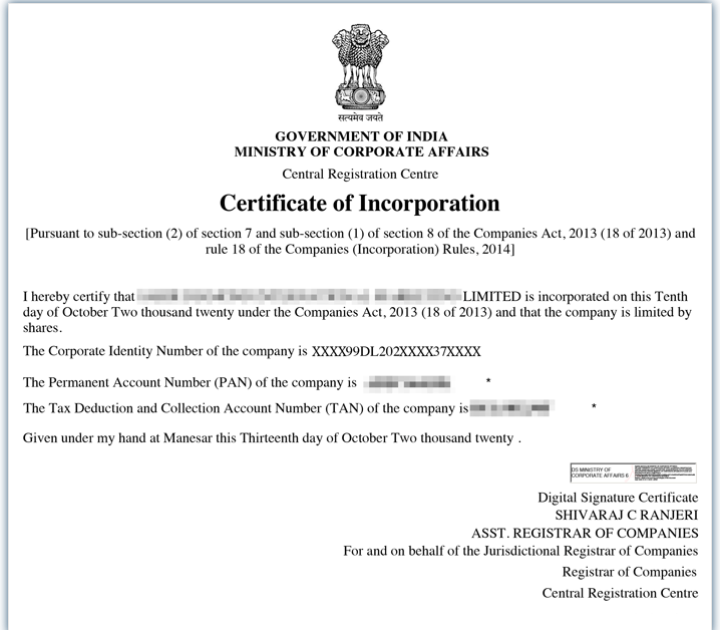
After successful incorporation of the Public Limited Company, you will receive the following official documents issued by the Ministry of Corporate Affairs (MCA):
| S. No. | Document Name | Purpose |
|---|---|---|
| 1 | Certificate of Incorporation (COI) | Confirms the legal existence of the company. |
| 2 | Permanent Account Number (PAN) | Required for taxation and financial transactions. |
| 3 | Tax Deduction and Collection Account Number (TAN) | Required for TDS and tax compliance. |
| 4 | Articles of Association (AOA) | Defines internal rules and company governance. |
| 5 | Memorandum of Association (MOA) | Defines company objectives and business scope. |
| 6 | Director Identification Number (DIN) | Unique identification number for directors. |
| 7 | Digital Signature Certificate (DSC) | Enables digital signing of official documents. |
| 8 | EPF and ESIC Registration Documents | Required for employee-related statutory compliance (if applicable). |
| 9 | Company Master Data | Contains CIN, registered address, and company details. |
The total cost for Public Limited Company Registration in India includes government charges and professional service fees. The overall registration cost starts from ₹11,999 and the incorporation process generally takes 14–21 working days, depending on document verification and approvals.
| Steps | Cost (₹) | Description |
|---|---|---|
| Digital Signature Certificate (DSC) | ₹7,000 | Required for directors to digitally sign incorporation documents and complete online filings. |
| Government Fees | ₹1,800 | Includes statutory filing charges payable to the Ministry of Corporate Affairs (MCA). |
| Professional Fees | ₹3,199 | Covers documentation, expert consultation, and filing support services. |
| Total Estimated Cost | ₹11,999* | Complete cost for Public Limited Company registration under standard conditions. |
A Public Limited Company is a type of business entity that provides limited liability protection to its shareholders and allows companies to raise capital by offering shares to the general public. It is governed under the Companies Act, 2013 and regulated by the Ministry of Corporate Affairs (MCA) in India.
A Public Limited Company can be incorporated with a minimum of 7 shareholders and at least 3 directors. This business structure is suitable for medium to large enterprises that require significant capital investment and plan to expand their operations through public funding.
Public Limited Companies also have the ability to list their shares on stock exchanges, enabling them to raise funds through Initial Public Offerings (IPO) and attract investors for long-term business growth.
Registering a Public Limited Company offers several financial, legal, and operational advantages that help businesses grow and build credibility.
One of the major benefits of a Public Limited Company is limited liability protection for shareholders.
This means:
This structure reduces personal financial risk and ensures business security.
A Public Limited Company operates as an independent legal entity, separate from its shareholders and directors.
This allows the company to:
This legal separation enhances business credibility and stability.
Public Limited Companies can raise funds from the general public by issuing shares.
This helps businesses:
Public investment supports long-term business growth.
Public Limited Companies generally enjoy greater credibility among investors, customers, and financial institutions.
Benefits include:
Being publicly registered increases transparency and trust.
Shares of a Public Limited Company can be freely transferred, making it easier for investors to buy or sell shares.
Unlike private limited companies:
This flexibility makes Public Limited Companies attractive to investors.
Sole proprietorship
Partnership firm
Farmer producer company
One person company
Limited liability company
Public limited company
Section-8
Trust registration
Micro finance company
Sole proprietorship
Partnership firm
Farmer producer company
One person company
Limited liability company
Public limited company
Section-8
Trust registration
Micro finance company
Copyright © 2025 easybusinessregistration